― Henry Miller, Sexus


Showing posts with label famous books. Show all posts
Showing posts with label famous books. Show all posts
Tuesday, March 19, 2013
,,,and everything you call yours
“I will go directly to her home, ring the bell, and walk in. Here I am, take me-or stab me to death. Stab the heart, stab the brains, stab the lungs, the kidneys, the viscera, the eyes, the ears. If only one organ be left alive you are doomed-doomed to be mine, forever, in this world and the next and all the worlds to come. I'm a desperado of love, a scalper, a slayer. I'm insatiable. I eat hair, dirty wax, dry blood clots, anything and everything you call yours. Show me your father, with his kites, his race horses, his free passes for the opera: I will eat them all, swallow them alive. Where is the chair you sit in, where is your favorite comb, your toothbrush, your nail file? Trot them out that I may devour them at one gulp. You have a sister more beautiful than yourself, you say. Show her to me-I want to lick the flesh from her bones.”

Sunday, February 24, 2013

Wednesday, January 30, 2013
Beauty and the Beast
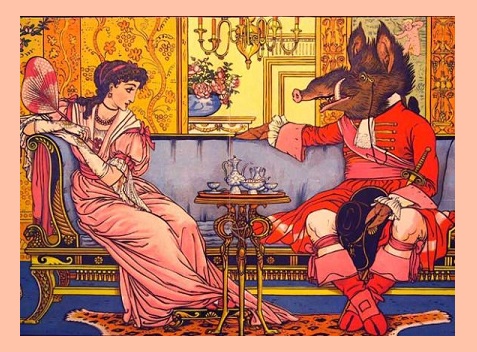
Once
upon a time, in a far-off country, there lived a merchant who had been so
fortunate in all his undertakings that he was enormously rich. As he had six sons
and six daughters, however, who were accustomed to having everything they
fancied, he did not find he had a penny too much. But misfortunes befell them. One
day their house caught fire and speedily burned to the ground, with all the
splendid furniture, books, pictures, gold, silver, and precious goods it
contained. The father suddenly lost every ship he had upon the sea, either by
dint of pirates, shipwreck, or fire. Then he heard that his clerks in distant
countries, whom he had trusted entirely, had proved unfaithful. And at last
from great wealth he fell into the direst poverty.
Read
it all here
Saturday, November 24, 2012

Thursday, November 8, 2012
Marquis de Sade' s Justine
Excerpt from Justine by Donatien Alphonse François, Marquis de Sade
They were given twenty-four hours to leave the convent; into their hands, together with their five score crowns, was thrown the responsibility to provide for themselves as they saw fit. Delighted to be her own mistress, Juliette spent a minute, perhaps two, wiping away Justine's tears, then, observing it was in vain, she fell to scolding instead of comforting her;she rebuked Justine for her sensitiveness; she told her, with a philosophic acuity far beyond her years, that in this world one must not be afflicted save by what affects one personally; that it was possible to find in oneself physical sensations of a sufficiently voluptuous piquancy to extinguish all the moral affections whose shock could be painful; that it was all the more essential so to proceed, since true wisdom consists infinitely more in doubling the sum of one's pleasures than in increasing the sum of one's pains; that, in a word, there was nothing one ought not do in order to deaden in oneself that perfidious sensibility from which none but others profit while to us it brings naught but troubles. But it is difficult to harden a gentle good heart, it resists the arguments of a toughened bad mind, and its solemn satisfactions console it for the loss of the bel-esprit's false splendors.
Juliette, employing other resources, then said to her sister, that with the age and the figure they both of them had, they could not die of hunger .She cited the example of one of their neighbors' daughters who, having escaped from her father's house, was presently very royally maintained and far happier, doubtless, than if she had remained at home with her family; one must, said Juliette, take good care to avoid believing it is marriage that renders a girl happy;that, a captive under the hymeneal laws, she has, with much ill-humor to suffer, a very slight measure of joys to expect; instead of which, were she to surrender herself to libertinage, she might always be able to protect herself against her lovers' moods, or be comforted by their number.

Thursday, November 1, 2012
Jack London
Excerpt from The Call of the Wild by Jack London,
This man had saved his life, which was something; but, further, he was the ideal master. Other men saw to the welfare of their dogs from a sense of duty and business expediency; he saw to the welfare of his as if they were his own children, because he could not help it. And he saw further. He never forgot a kindly greeting or a cheering word, and to sit down for a long talk with them (“gas” he called it) was as much his delight as theirs. He had a way of taking Buck’s head roughly between his hands, and resting his own head upon Buck’s, of shaking him back and forth, the while calling him ill names that to Buck were love names. Buck knew no greater joy than that rough embrace and the sound of murmured oaths, and at each jerk back and forth it seemed that his heart would be shaken out of his body, so great was its ecstasy. And when, released, he sprang to his feet, his mouth laughing, his eyes eloquent, his throat vibrant with unuttered sound, and in that fashion remained without movement, John Thornton would reverently exclaim, “God! you can all but speak!”

Subscribe to:
Posts (Atom)